
Executive Summary:
- Maintaining state and FLSA compliance is the most important task for every HR team.
- Compensable work time is defined as any employee time spent performing job related tasks.
- Overtime and rest break regulations stand as the most common compliance snags for SMB’s.
- If you’re unsure about an employee’s classification or exemption status, err on the side of caution and reach out to an HR management professional.
When you think of what makes a successful business, chances are you picture a trailblazing CEO, a flashy sales team, an eccentric marketing department. And while all of these people do contribute greatly to the growth and development of their companies, the quiet hero of every operation is Human Resources. Their job is unlike any other, fostering company culture, bringing in talented team members, and maintaining compliance to keep the ship afloat. If sales and marketing are building from the ground up, the HR department acts as the ground they’re standing on.
As an HCM, our team at Payday gets asked frequently “what is HR compliance?”. HR compliance is the continued process of ensuring all business policies, processes, and operations adhere to federal, state, and local regulations and labor laws. From the moment an employee is hired until their final day on the job, HR keeps a watchful eye to make sure they are handled appropriately, paid properly, and receive every and all workers rights entitlements. We know just how much weight compliance carries in your overall business, as well as its dominance in every HR representative’s workload. Our mission at Payday HCM is to help all prospective and current clients get the information they need to run their business with confidence.
So, in this article, we are going to go over important hour and wage compliance standards to ensure your hourly workers are being handled fairly and in accordance with the law.
- FLSA, OSHA, and Other Notable Regulations
- Compensable Time and Work Week Structure
- Overtime and Break Requirements
- Employee Classifications and Exemptions
FLSA, OSHA, and Other Notable Regulations
As your business rule books, knowing the ins and outs of the FLSA and its associated laws and acts is crucial to keeping all of your business operations above board.
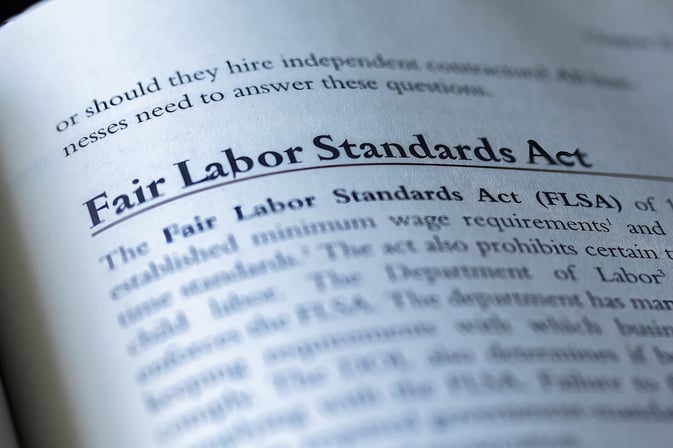
Fair Labor Standards Act (FLSA)
Enacted in 1938, the FLSA functions as the primary dogma for most private and public sector businesses. It establishes the non-negotiable, fundamental protections for employees, specifically outlining child labor, federal minimum wage, record keeping practices, and overtime standards. The FLSA stands as the foundational tenets, providing that baseline for states to build off of. This is when you see the introduction of higher minimum wages, varying meal and break requirements, and other jurisdiction specific laws.
Paramount to upholding your FLSA compliance is having a comprehensive timekeeping and record keeping system. Having clear and consistent records of every employee’s hours worked per workweek will ensure accurate wage and overtime calculations, as well as saving you from costly fines and interpersonal disputes. FLSA record keeping standards require all employers to uphold accurate employee records with names, occupations, addresses, pay rates, total hours and earnings, etc. Having integrated systems helps in streamlining these processes and keeping your company audit ready.
Other Important Acts to Be Aware Of
In addition to the FLSA, business owners must also be aware of the Occupational Safety and Health Act (OSHA) which requires employers to provide a hazard free work environment. HR departments successfully meeting OSHA compliance would provide training for employees, establish risk free incident reporting, and perform routine safety audits.
Beyond these, there are also many important human rights acts in place to protect your employees from any unjust discrimination. The Americans with Disabilities Act (ADA), Age Discrimination in Employment Act (ADEA), and Title VII of the Civil Rights Act forbid employers from discriminating on the basis of race, religion, gender, sexual orientation, disability status, or age. The Equal Employment Opportunities Commission (EEOC) upholds these laws, so establishing a zero tolerance workspace and conducting discrimination and harassment training is a good way to stay out of trouble.
Additionally, there are some regulations in place to protect workers health and benefits. The Family Medical Leave Act (FMLA) allows employees 12 weeks of unpaid, protected leave for specific family and medical reasons. The ACA dictates affordable health care for all employees, and COBRA allows employees to keep their existing healthcare for a set period of time during life changes. Knowing all of these labor laws intimately and having an HR system that has built in compliance alerts will make juggling all of these rules more manageable.
Compensable Time and Work Week Structure
Accurate pay and timekeeping are the bedrock of wage and hour compliance. Having a comprehensive understanding of compensable work time and how many hours your employees are legally allowed to work is imperative.
Compensable “Work Time”
According to the FLSA, “work time” is defined as any time an employee is enduring or permitted to work. If you as an employer know your employees are performing work related tasks, even if you didn’t explicitly ask them to, you must pay them. Payable work time also includes travel time between work sites, short breaks, mandatory meetings, and any pre/post shift procedures that are integral to job responsibilities.
Gray area work times refer to moments when employees are on call for prolonged periods or required to stay on the premises even if they aren’t actively performing their duties. Per FLSA standards, employers must pay for every hour worked regardless of if the hourly employee recorded it or not. Forcing employees to work off the clock or turning a blind eye to this action is strictly prohibited.
The Legal Work Week
Again following FLSA standards, the work week is defined as any 168 hours that elapse during seven 24 hour periods. However, there is no specific rule dictating which day or hour the work week must begin, instead leaving it up to employers discretion. While you can have hourly employees work any number of hours during any preset work week, maintaining regular work hours is key in preventing potential employee exploitation and ensuring fair compensation.
Another important thing to be aware of when talking about the legal work week and timekeeping is the seven minute rule. This rule allows employers to round any hourly employee clock in/out time to the nearest quarter hour, so if an employee clocks in at 12:07, you may round their clock in time down to 12:00, but if they clock in at 12:08, it would be rounded up to 12:15. Establishing a transparent timekeeping system that requires some sort of employee verification or input is a good way to avoid disputes, compliance hiccups, and improperly logged hours.
Overtime and Break Requirements
As the most common snag for small businesses, overtime laws and meal and rest break regulations can be deceptively challenging to fully grasp.
Overtime Compliance
Overtime is any hour over 40 hours that an employee works in a given work week and the additional pay that they receive for doing so. Following FLSA mandates, the calculation for OT pay is 1.5 times an employee's regular pay rate for every hour over that 40. Keep in mind that regular pay is not just their hourly wage but any shift differentials, non-discretionary bonuses, or commissions your employee may have. Although the FLSA does not cap how many hours can be worked in a given workday, certain states have more stringent rules in this area. California, for example, necessitates OT pay for any hours worked after 8 in a given day, and double time for any hours worked over 12. Being fully educated on specific state and union overtime rules will help avoid non-compliance.
Now, many employees ask the question: “can a company force you to work overtime?”. In short, yes, employers are legally allowed to require OT as a condition of employment. Because there are no federal laws prohibiting this, many states follow suit, meaning a refusal to work company required overtime can result in disciplinary action. There are some states, however, that have predictive scheduling laws or mandatory overtime restrictions in place, so this really depends on your specific jurisdiction. For employers, while mandatory OT is technically FLSA compliant, it is not great for employee morale. Be sure to weigh the pros and cons of a mandate like this before making it commonplace in your business.
Break Requirements
Unlike most other wage and hour compliance regulations, break requirements show the largest gap between state and federal laws. The FLSA does not legally require breaks to be provided for adult workers. The only rule they do specify here is that breaks under 20 minutes must be paid while breaks of 30 minutes or more (gaps of time considered to be full reliefs from duty) can be unpaid.
It’s when you start looking at state specific requirements that these laws become more strict. New York and California are primary examples of states with strong employee leaning rules, dictating when in the shift meal and rest breaks need to be taken and issuing penalties for missing or interrupted breaks. CA requires a paid 10 minute break for every four hours worked while NY necessitates an unpaid 30 minute break for any shift over six hours. However, states like Texas default to FLSA compliance standards. When in doubt, default to your state requirements. Failure to provide breaks can result in class action lawsuits, expensive fines, and poor employee health.

Employee Classifications and Exemptions
In addition to knowing when and how much to pay your workers, having a solid understanding of who exactly your workers are will keep you from any missteps.
Employee vs. Independent Contractor
Misclassifying an employee as an independent contractor is one of the most costly errors an employer can make. Employees are defined as any individual under an employer control whereas independent contractors are defined as autonomous workers. Legally, employees are entitled to certain benefits and overtime compensation, and employers must pay payroll taxes for them. When it comes to independent contractors, however, employers are not responsible for them to such a serious degree.
Although misclassifications may occur as genuine mistakes, the result of all of them is back taxes, lost wages, and serious penalties. Both the IRS and DOL have multi factor tests to determine employee classification, providing you a definitive resource to avoid compliance mishaps. As a rule of thumb, always lean to the side of caution and go with classification; if you follow the online tests and are still unsure, reach out to an HR representative for confirmation.
Exempt vs. Non-Exempt Employees
Following federal guidelines, exempt employees are excused from certain FLSA mandates while non-exempt employees still fall under the FLSA jurisdiction. Exempt employees are those who are salaried above a certain level and work in administrative or executive roles. This means that employers are not legally required to pay exempt employees overtime pay.
Non-exempt employees, on the other hand, generally earn an hourly wage or salary below the predetermined DOL threshold. These individuals are entitled to minimum wage, either the federal $7.25 or their state minimum wage if it’s higher, as well as overtime pay when applicable. As with employee classification, the DOL provides a guide to determine employee exemption so you can guarantee FLSA compliance.
Providing Unbreakable HR Infrastructure
HR compliance is no joke; with fluctuating rules, a veritable alphabet of important acronyms, and a mountain of hours to track, keeping your business standard where it needs to be takes a lot of work. Beyond federal decrees and the threat of fines, you have your employees to worry about. Ensuring their fair treatment, protection, and compensation is your Human Resource departments primary goal, as businesses are nothing without their workers.
This is where Payday comes in. As an HCM, we have always known the importance of HR, proper timekeeping, accurate documentation, and upholding compliance. Our around the clock service and top tier HR team are here as a resource for all of your compliance questions and needs. Keeping a firm grasp on every federal, state, and local law is too much for any set of hands, which is why we are here, arms outstretched, ready for any mishaps that might happen. Searching for a wage and hour compliance solution? Look no further than Payday HCM.
Frequently Asked Questions (FAQs):
Q: How does overtime calculation work, and can it handle state-specific overtime rules?
PaydayHCM automatically calculates overtime based on federal FLSA rules (1.5x after 40 hours/week) and state-specific rules such as California's daily overtime (1.5x after 8 hours/day, 2x after 12 hours). Rules are applied per employee based on work location. Read about FLSA overtime rules.
Q: Can Payday HCM help with labor law compliance specific to the hospitality industry?
Yes, we stay up-to-date on all federal, state, and local labor laws, including those specific to hospitality, such as overtime, meal breaks, and tip credits. Our system ensures your payroll is always in compliance, minimizing the risk of costly penalties.
Q: What is Human Resources (HR), and why does my business need it?
Human Resources (HR) is the business function responsible for managing the people who work for your organization. This includes recruiting and hiring, onboarding, employee relations, performance management, compliance with labor laws, and managing compensation and benefits. Even small businesses need HR support—without it, you're exposed to compliance risks, higher turnover, employee dissatisfaction, and potential lawsuits. Whether you staff an internal HR department or partner with an HCM provider to handle these functions, having solid HR infrastructure is essential for sustainable business growth.
Topics: