
Executive Summary:
- ACA reporting requirements dictate that ALEs must provide affordable, minimum coverage, employer sponsored healthcare to all eligible full-time employees.
- Full-time employees can be determined using either the look back measurement method or the monthly measurement method.
- Seasonal workers, while not generally eligible for ACA required healthcare, do typically count towards your FTE calculations.
- The Forms 1094-C and 1095-C due date for filing the 2026 reporting year is March 31st, 2027.
If you’re a business owner or an HR administrator, chances are you’ve heard of the ACA. The Affordable Care Act, colloquially known as Obamacare, was passed in 2010 and ensures full-time equivalent employees have access to affordable, employer provided health insurance. Although it is an incredibly beneficial program that keeps your workers safe and protected, keeping up with ACA reporting deadlines and requirements can be a considerable stressor for your business administration team. With mountains of employee information and hours to accurately document, important furnishing and filing deadlines to stay on top of, and complicated forms to fill out for every employee annually, maintaining ACA compliance can be a daunting task for those not trained for it.
Our HR and benefits teams at Payday HCM are no stranger to the ins and outs of ACA regulations. We know full well just how important it is to have strong time keeping systems in place, organized document indexes, and meticulous administrative workers who can keep submissions accurate and timely. With Forms 1094-C and 1095-C floating in the broth of the compliance alphabet soup, we aim to be your educators and your support team.
Year end is right around the corner, which means a fresh wave of impending ACA deadlines. So, to ensure your preparedness, we are going to take a deep dive into this ACA stew, giving you all the information you need to keep your business in the good graces of the IRS.
- ACA Reporting Requirements
- Employment Status and Seasonal Workers
- ACA Reporting Deadlines and Penalties
ACA Reporting Requirements
Having a thorough understanding of everything is required by the ACA will keep your reports accurate and uphold your compliance.
Applicable Large Employers (ALEs)
According to the ACA, an employer is considered an ALE if they employ at least 50 full time employees. This means if your workforce averaged 50+ full-time, or full-time equivalent (FTE) employees, during the previous calendar year, you are required to provide affordable, employer sponsored healthcare for each of them. Here, a full-time employee is defined as an individual working more than 30 hours per week.
Businesses that do not meet ALE status are therefore not subject to the employer information reporting provisions or the employer shared responsibility provisions for the current calendar year. That does not mean, however, that they are barred from providing employee benefits. Many employers choose to offer them as a way of attracting and retaining talent.
The Employer Mandate
Under the ACA instated employer shared responsibility provision, one of the primary things ALEs must do is provide employees with minimum essential coverage (MEC). ALEs are responsible for covering a certain portion of their full-time employees premiums to ensure their health coverage meets the IRS affordability threshold. If the amount employees are left to pay goes over said threshold, employers may be subject to serious tax penalties.
ACA reporting, then, acts as your paper trail: it proves that your business offered MEC to at least 95% of your full-time employees, and that said coverage was truly affordable and met the minimum value standard. Again, if your business does not reach ALE status (having a workforce of less than 50 full-time/FTEs), the employer shared responsibility mandate generally does not apply to you.
ACA Affordability and Minimum Value
When we talk about IRS affordability, what we’re really discussing is if an employee’s share of their self-coverage stays below a certain percentage of their income. This percentage is calculated using the lowest common earners household income as a baseline, ensuring widespread affordability. The IRS adjusts this percentage annually, but for plan years beginning in 2027, the affordability threshold is set at 10.22% (up from the 2026 9.96%). When calculating affordability, employers are allowed to reference employee W2 forms, employee’s pay rate, as well as the federal minimum wage.
Beyond affordability, ACA compliance for employers asserts that this health coverage must provide comprehensive minimum value. In layman's terms, this is understood as employer provided health insurance covering at least 60% of the total allowed costs “expected to be incurred under the plan”. This means the plan must cover a substantial amount of any physician or in-patient hospitalization services.
ACA Forms 1094-C and 1095-C
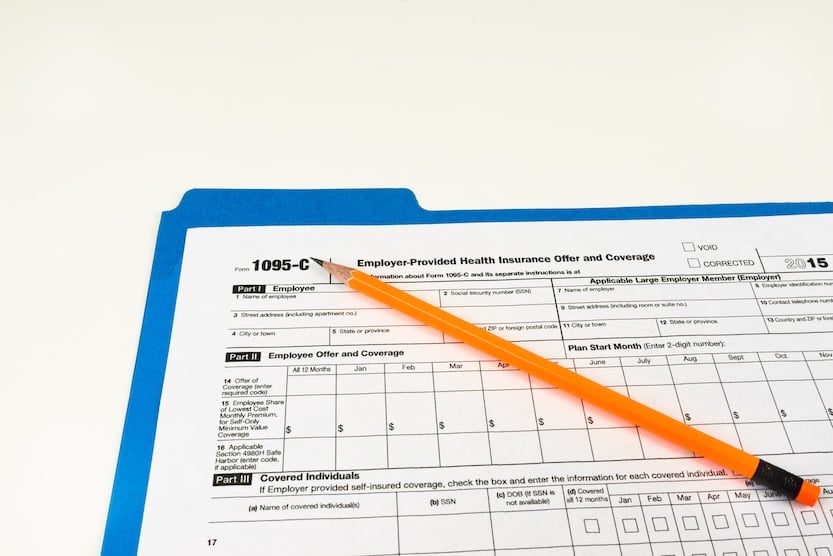
Forms 1094-C and 1095-C stand as the foundations of all ACA reporting. These are the forms that ALEs furnish, file, and submit to the IRS to prove their ACA compliance. Form 1095-C is completed for each individual full-time employee, and details all of their coverage offerings in a given calendar year. Form 1095-C must be filed for every individual you employed that year, regardless of their recent termination status or if they declined the employer sponsored health insurance.
Form 1094-C is a summary of all of your 1095-C forms, summarizing ACA data and certifying that at least 95% of your full-time employees were offered coverage. It is important to remember that the information needed for Forms 1094-C and 1095-C exist across your benefits administration, payroll, and HRIS platforms. If these are separate systems, consolidation can be challenging. Having a fully integrated HRIS or HCM provider makes the furnishing and filing of these ACA forms much easier.
Employment Status and Seasonal Workers
Properly classifying your employees as full-time, part-time, or seasonal will save you from incurring any ACA compliance penalties.
Full-Time vs. Part-Time Employees
As aforementioned, a full-time employee is defined as someone working more than 30 hours in a given work week, or 130 hours in a given month. Part-time employees are, alternatively, individuals working less than 30 hours per week or 130 hours per month. However, even if your business is comprised primarily of part-timers, and even if you have less than 50 full time employees on staff, their combined hours may qualify them as full-time equivalent employees (FTEs). In this case, your business would still be subject to ACA reporting requirements.
When calculating your FTE status, you add the total hours of all of your part-time employees for the month and divide by 120. You would then add the number of full-time employees on staff to this number. If your FTE average number is higher than 50 for the prior year, you will have to follow ACA regulations. Especially in restaurant and hospitality industries, those with part-time workforces and high turnover rates, it is crucial to calculate your FTE status at the start of every calendar year in order to maintain compliance.
Look Back Measurement Method vs. Monthly Measurement Method
The two methods used to determine an employee's full-time status are the look back measurement method and the monthly measurement method. The look back method is highly recommended, as it tracks employee hours over a set period, and then calculates the average hours worked to determine full-time eligibility.
When using the look back method, there are three phases of time to be aware of:
- The Measurement or Look Back Period: a defined stretch of 6 or 12 consecutive months where employee hours are tracked to see if they average more than 30 hours per week.
- The Administrative Period or Open Enrollment Period: generally aligning with the open enrollment period, this is a 60 day stretch where the results of the measurement period are reviewed and coverage is offered to eligible full-time employees.
- The Stability Period or Plan Year: after the measurement and stability periods, employees retain either full or part-time status regardless of the average hours they work during this time.
The monthly measurement method, on the other hand, has employers tracking employee worked hours every calendar month for each worker, using that 130 per month as the full-time threshold. If an employee reaches that full-time eligibility, you are required to offer them coverage for the month. There are a few disadvantages to the monthly measurement method, though, as it can be incredibly administratively tedious for larger hourly workforces. Additionally you must offer coverage for the month prior to tracking the applicable hours.
Seasonal Workers and the 120 Day Rule
The ACA defines a seasonal worker as an individual who is hired for a position where the agreed upon annual employment is 6 months or less. Real world examples of seasonal workers would be November and December hires at popular retailers, working exclusively during the holiday season. Or college students working their summer months at a restaurant to get a little extra money. Because of the impact seasonal employment can have on your workforce, seasonal workers are typically included in your FTE calculation.
The exemption from this FTE calculation inclusion is where the 120 day rule comes in. This rule states that if you had over 50 employees for less than 120 days during the calendar year, and if during those 120 days you had less than 50 employees, excluding your seasonal workers, then you are not required to count those seasonal employees towards the FTE calculation. Another important note here is that the 120 days do not have to be consecutive, so long as they all exist in a single calendar year.

How Do I Handle Benefits for Part-Time and Seasonal Employees?
The ACA only requires benefits be provided to full time and full time equivalent employees, meaning employers are not legally obligated to provide health insurance for part-time and seasonal employees.
However, that doesn’t mean that PTEs and seasonal workers are completely redlined from receiving benefits - it is largely up to the employer to decide. Some employers offer holiday pay, bonuses, or limited PTO hours to their PTEs as a way to bolster employee retention.
ACA Reporting Deadlines and Penalties
Paramount to proper ACA reporting and avoiding any substantial penalties is being aware of all major ACA reporting deadlines as well as the proper way to file.
Reporting Deadlines
The three most important dates to mark your calendars with for the 2026 reporting year are:
- March 1st, 2027: if you are eligible, file your Forms 1094-C and 1095-C via paper with the IRS.
- March 2nd, 2027: furnish Form 1095-C to every full-time employee and FTE on your staff.
- March 31st, 2027: file Forms 1094-C and 1095-C electronically with the IRS.
Be aware that the March 2nd furnishing due date is the extended deadline, meaning you must send Form 1095-C to all eligible employees by this deadline or risk accruing compliance penalties.
Paper vs. Electronic Filing
For most employers, electronic filing is the only way to submit your forms to the IRS. If your business files more than 10 total information returns (Form 1095-C, 1099s, and W2s) in a given calendar year, you must e-file. And for ALEs, paper filing is no longer an option.
The IRS now has a required e-filing system called the Affordable Care Act Information Returns (AIR) system. As per AIR system guidelines, all information must be formatted as XML schema for proper transmission. All Forms 1094-C and 1095-C must be filed via AIR systems, a process that average employers cannot handle without support from an ACA reporting vendor, so having an applicable HR or HCM provider significantly simplifies this process. Also note that without a valid Transmitter Control Code (TCC), you will be unable to file via AIR, so be sure to identify your business TCC well before the March deadlines.
Penalties to Be Aware Of
As the primary employee benefits watchdog, the ACA issues some considerable penalties to businesses that fail to abide by their rules. These penalties are typically adjusted based on the number of employees receiving premium tax credits and on how many months elapsed during the prior year where they failed to receive adequate coverage.
Some of the most severe penalties include, but are not limited to:
- Failure to Offer Coverage (4980H(a)): ALEs that do not provide minimum essential coverage to at least 95% of their full-time employees and those employees dependants are subject to a $3,340 fine per employee affected.
- Failure to Provide Affordable Coverage (4980H(b)): if the IRS finds coverage unaffordable, or if it fails to provide minimum value, employers are subject to a $5,010 penalty for every full-timer who receives a premium tax credit.
- Failure to File ACA Reports: any late or incorrect ACA filings, so Forms 1094-C and 1095-C, have a fine of $60-$340 per form, with exact amount depending on date submitted. Any ALEs found willfully disregarding ACA filing will be fined $680 per form.
Accurately tracking employee hours, and filing ACA forms accurately and on time will save you from missed compliance and related fines.
Payday HCM As Your ACA Reporting Solution
As we have seen, ACA reporting requirements for employers are considerable. Ensuring your employees are adequately covered, tracking hours accurately, and avoiding ACA compliance snags is quite the juggling act. Without proper ACA compliance, your workers may be unsatisfied and vulnerable to the unfortunate surprises life has in store. But with a solid ACA reporting system, you will be able to safeguard your most important assets and stay clear in the eyes of the IRS.
Our team at Payday HCM is approached constantly by people saying “I need benefits administration software that handles 1095-C reporting.” Luckily for them, and for you, that is one of our primary functions as a full-service HCM. Our benefits administration team is highly knowledgeable and will be there to help you with every step of your ACA reporting journey. Additionally, our HR management department will be able to fully train and educate your human resource administrators to keep business operations compliant and streamlined. Don’t take any chances with your ACA reporting, see how Payday HCM can help today.
Frequently Asked Questions (FAQs):
Q: How many employees do you need before the ACA employer mandate applies?
To be considered an applicable large employer (ALE) and be subject to the ACA employer mandate, your business must have 50+ full-time or full-time equivalent (FTE) employees. Remember, part-time employees contribute to your FTE count, so be sure to track hours accurately.
Q: When are ACA reporting deadlines?
For the 2026 reporting year, March 2nd, 2027, is the Form 1095-C employee furnishing deadline, and March 31st, 2027, is the deadline for e-filing Forms 1094-C and 1095-C with the IRS.
Q: Which payroll companies handle ACA reporting, 1095-C filing, and employer mandate compliance for you?
While most modern payroll solutions handle ACA reporting and filing, Payday HCM is especially qualified for the task. Our software tracks ACA eligibility, generates 1095-C forms for employees, and files 1094-C with the IRS electronically. The system monitors full-time equivalent counts and alerts you if you're approaching ACA employer mandate thresholds.
Topics: